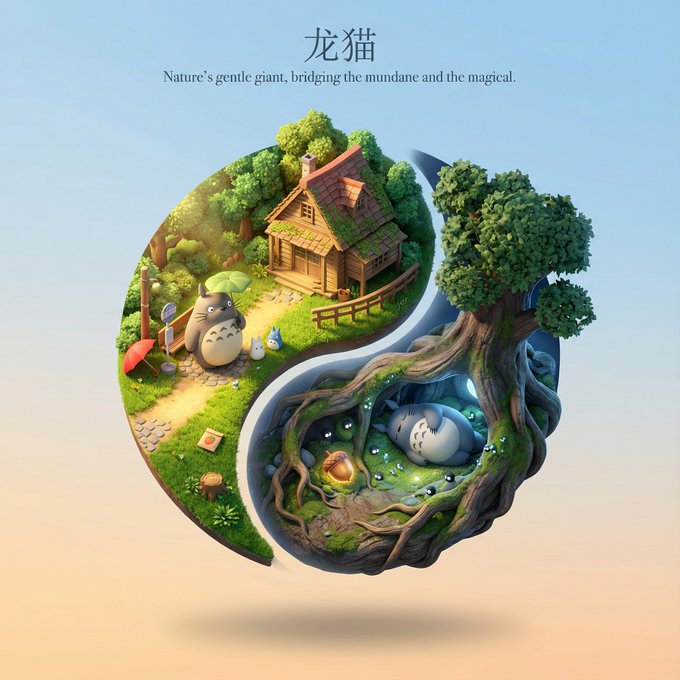
漂浮的太极可爱3D卡通立体场景
Prompt
A clear, floating cute 3D cartoon diorama scene in a circular composition with rotational symmetry, echoing a yin-yang layout:

Scene:
- a single floating circular emblem viewed from isometric bird's-eye perspective (45° angle looking down).
- one swirling half of the circle shows [Subject]'s most iconic defining scene or aspect (primary realm).
- the opposite swirling half is the contrasting opposite realm, occupying the complementary yin-yang territory.
- both realms share the same gravity direction and isometric orientation.
- each half may be a continuous shared landmass OR two structurally separate diorama units that curve around each other, forming a recognizable yin-yang composition.

Interpret narrative essence:
- treat [Subject] as ONE overarching theme or entity with TWO conflicting aspects.
- let each realm embody one aspect in a clear, visual way: the first half leans into aspect A, the opposite half leans into aspect B.
- use characters only where they naturally serve the contrast: they may appear in one realm, both realms, or take different forms — repetition is optional, never a strict requirement.
- place 2 distinct symbolic objects, each rooted naturally in its own world, echoing each other across the curve to suggest what was abandoned or gained between these two aspects.

Yin-yang relationship:
- design the two realms as interlocking, yin-yang-like shapes inside the circle: interlocking territories that echo yin-yang flow.
- place the most focal element of each realm at its "yin-yang eye" position — the visual anchor point within each half's territory.
- the two realms should feel spatially intimate and cohesive — bring them closer together to create a unified, compact circular emblem rather than loosely scattered islands.
- the two halves are typically structurally separate with a subtle atmospheric gap, but may share ground where narrative calls for it — when adjoining, boundaries flow naturally through lighting, color temperature, and ground material shifts.
- edge treatment: encourage organic overflow at key points — tall structures gently break the circular silhouette, ground edges fade atmospherically rather than clip sharply.

Composition:
- clean, dramatic circular multiverse — the circle reads as one unified, spatially compact emblem, with two interlocking narrative poles sitting close and relating to each other.
- amplify contrast between the two realms: maximize visual tension to make the duality unmistakable.
- vast open view: the scene extends naturally to its edges without boundary walls, fences, or enclosures — the horizon remains visible and unobstructed.

Shadow:
BARELY visible, extremely soft non-contact shadow with expansive fadeout — extends well beyond the diorama's footprint with a gentle gradient that blurs into the background. Viewed from bird's-eye perspective, nearly circular in shape.

Render:
- C4D. high poly with soft shading, rounded edges and bevels.
- realistic PBR materials with tactile authenticity — avoid glossy plastic or resin appearance.
- intricate textures, delicate detail, vivid harmonized colors. SSS texture:true.
- CRITICAL: ground planes must remain flat and level with natural material textures appropriate to each realm.

Background:
- a single unified, clean, subtle gradient sky as the shared environment of both realms, providing generous breathing space around the circular diorama.

Typography (top-center, cinematic poster-style design):
- a prominent title "[Subject]" in a slim elegant serif (remove the brackets).
- beneath it, a poetic, insightful subtitle that distills the story’s deepest truth or tension into one profound line.
- create clear visual hierarchy through scale and weight contrast; allow auto line wrap and slight overlap with the top of the circle if needed.

Enhance:
- professional cinematic lighting, shaped to emphasize the contrast between the two realms while keeping both legible.
- if characters are present, use dynamic, emotionally expressive poses that clearly align with the aspect of their realm.
- strong sense of visual depth within each realm.

Scene / lighting / cultural aesthetics:
- contextually appropriate to [Subject].

Negative:
- [cropped elements at canvas edges, plastic/resin, hard cartoon outlines, underexposed, creepy, ceiling].

ar=1:1
[Subject] =
- Category
- 创意图片
- Model
- Nano Banana Pro
- Creator
- @eviljer
- Source ID
- 7e924f64-33cc-4246-9c0b-480412136da5
- Published
- Dec 27, 2025
Views7