Generate a cohesive visual series of high-fidelity infographic-style images form
Generate a cohesive visual series of high-fidelity infographic-style images forming a unified art-history knowledge s...
- 分类
- 图表信息图
- 模型
- GPT Image 2
- 来源作者
- xie underwood
- 原始语言
- en
- 来源 ID
- 5227
- 发布时间
- 2026年5月16日
完整提示词
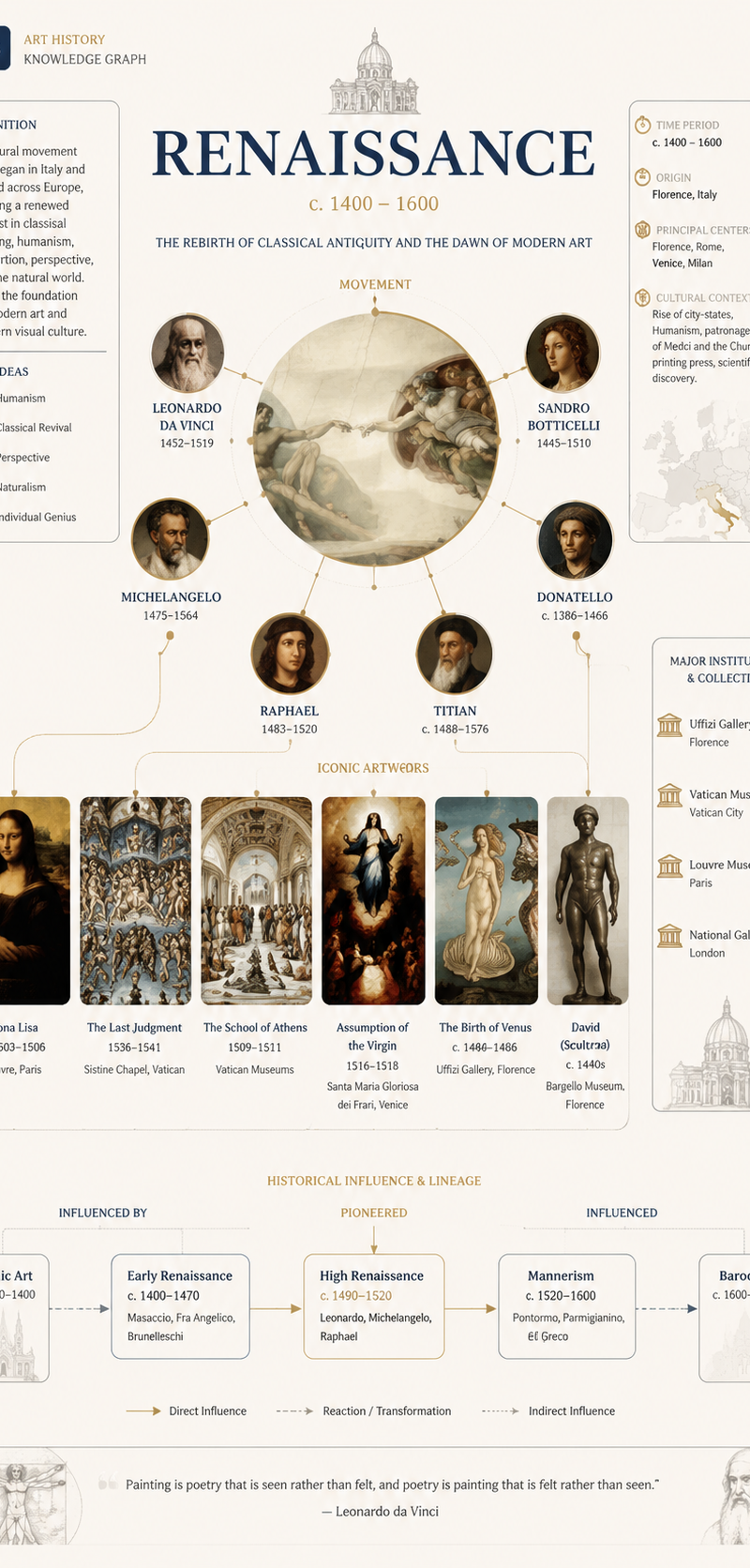
Generate a cohesive visual series of high-fidelity infographic-style images forming a unified art-history knowledge system presented as a carousel dataset. The core objective is to visually map the most influential and historically significant art styles in human history, and for each style clearly identify representative artists, iconic artworks, and their historical and cultural influence within the evolution of art, constructing a structured and interconnected art history intelligence graph across multiple movements. Each selected art style must generate one dedicated infographic image centered on that single movement, automatically inferring authoritative art history knowledge including definition and time period, globally recognized representative artists, museum-level iconic artworks, and lineage relationships with preceding and succeeding movements, while constructing a structured knowledge graph where nodes represent artists, artworks, movements, and optionally institutions such as museums or academies, and connections are clearly labeled relationships such as influenced by, reaction against, student of, museum collection of, or pioneer of.

A key visual requirement is that every single image must include rich visual references of art to enhance aesthetic depth and cultural clarity. This means each infographic should contain actual artwork representations, such as embedded paintings, artwork thumbnails, or visual excerpts of iconic works, and where appropriate include portrait representations of the artists themselves, ensuring that each composition feels visually enriched, museum-like, and emotionally engaging rather than purely diagrammatic. These artistic visuals must be naturally integrated into the knowledge graph nodes as image cards or portrait nodes, without breaking layout consistency or reducing readability.

All images must use a consistent visual system with a soft neutral off-white or very light museum-gray gradient background with zero variation across the entire series, avoiding any dark themes or color mood shifts, creating the feeling of a unified museum archive or art history intelligence database. Typography must follow an elegant modern serif or editorial sans-serif hybrid consistent with museum catalog design, ensuring all text is fully readable, properly spaced, and never stretched, warped, compressed, or perspective-distorted, with strict hierarchy where the art style name is the largest title, artists are medium-sized labels, artworks are slightly smaller but still legible, and metadata remains minimal and subtle.

The visual style should feel like a high-end museum catalog combined with an art history textbook and Apple-level information design, using a clean grid-based editorial layout, subtle archival texture, soft shadows, restrained elegance, and thin connection lines in sepia, charcoal, or muted blue. Layout rules must remain identical across all images, using a consistent node system where movements are central or dominant nodes, artists are circular nodes, artworks are rectangular image cards, institutions are rounded rectangles, and influences are directional arrows with solid lines for direct influence, dashed lines for stylistic reaction or reinterpretation, and dotted lines for indirect lineage. Visual hierarchy must clearly place the art movement at the center, with artists clustered closely around it, artworks attached to artists, and broader context fading into the outer layer.

Content integrity must rely only on historically verified and widely accepted art history knowledge, strictly avoiding fictional artists, artworks, or movements, and focusing on canonical movements such as Renaissance, Baroque, Impressionism, Cubism, Surrealism, and Abstract Expressionism, prioritizing museum-level consensus and academic accuracy.

The final output must be a cohesive carousel-style dataset where each image represents one art style knowledge graph, continuing across multiple major canonical movements in a consistent sequence, forming a unified museum-grade art history intelligence system with zero visual drift, high readability, dense structured information, and a premium editorial aesthetic comparable to a Bloomberg terminal for art history combined with MoMA archival visualization and Apple-level information design.
多语言1
Generate a cohesive visual series of high-fidelity infographic-style images form
enGenerate a cohesive visual series of high-fidelity infographic-style images forming a unified art-history knowledge system presented as a carousel dataset. The core objective is to visually map the most influential and historically significant art styles in human history, and for each style clearly identify representative artists, iconic artworks, and their historical and cultural influence within the evolution of art, constructing a structured and interconnected art history intelligence graph across multiple movements. Each selected art style must generate one dedicated infographic image centered on that single movement, automatically inferring authoritative art history knowledge including definition and time period, globally recognized representative artists, museum-level iconic artworks, and lineage relationships with preceding and succeeding movements, while constructing a structured knowledge graph where nodes represent artists, artworks, movements, and optionally institutions such as museums or academies, and connections are clearly labeled relationships such as influenced by, reaction against, student of, museum collection of, or pioneer of. A key visual requirement is that every single image must include rich visual references of art to enhance aesthetic depth and cultural clarity. This means each infographic should contain actual artwork representations, such as embedded paintings, artwork thumbnails, or visual excerpts of iconic works, and where appropriate include portrait representations of the artists themselves, ensuring that each composition feels visually enriched, museum-like, and emotionally engaging rather than purely diagrammatic. These artistic visuals must be naturally integrated into the knowledge graph nodes as image cards or portrait nodes, without breaking layout consistency or reducing readability. All images must use a consistent visual system with a soft neutral off-white or very light museum-gray gradient background with zero variation across the entire series, avoiding any dark themes or color mood shifts, creating the feeling of a unified museum archive or art history intelligence database. Typography must follow an elegant modern serif or editorial sans-serif hybrid consistent with museum catalog design, ensuring all text is fully readable, properly spaced, and never stretched, warped, compressed, or perspective-distorted, with strict hierarchy where the art style name is the largest title, artists are medium-sized labels, artworks are slightly smaller but still legible, and metadata remains minimal and subtle. The visual style should feel like a high-end museum catalog combined with an art history textbook and Apple-level information design, using a clean grid-based editorial layout, subtle archival texture, soft shadows, restrained elegance, and thin connection lines in sepia, charcoal, or muted blue. Layout rules must remain identical across all images, using a consistent node system where movements are central or dominant nodes, artists are circular nodes, artworks are rectangular image cards, institutions are rounded rectangles, and influences are directional arrows with solid lines for direct influence, dashed lines for stylistic reaction or reinterpretation, and dotted lines for indirect lineage. Visual hierarchy must clearly place the art movement at the center, with artists clustered closely around it, artworks attached to artists, and broader context fading into the outer layer. Content integrity must rely only on historically verified and widely accepted art history knowledge, strictly avoiding fictional artists, artworks, or movements, and focusing on canonical movements such as Renaissance, Baroque, Impressionism, Cubism, Surrealism, and Abstract Expressionism, prioritizing museum-level consensus and academic accuracy. The final output must be a cohesive carousel-style dataset where each image represents one art style knowledge graph, continuing across multiple major canonical movements in a consistent sequence, forming a unified museum-grade art history intelligence system with zero visual drift, high readability, dense structured information, and a premium editorial aesthetic comparable to a Bloomberg terminal for art history combined with MoMA archival visualization and Apple-level information design.